
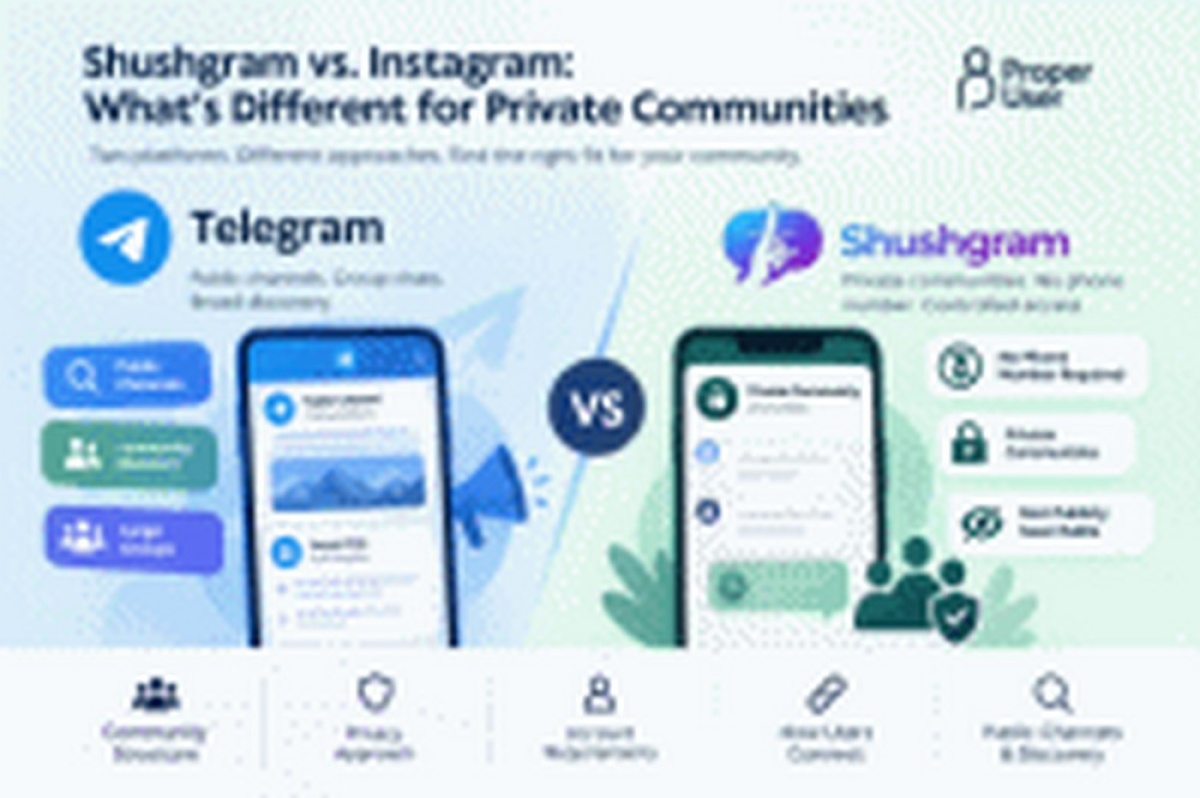
Telegram and Shushgram take different approaches to these needs. Telegram combines private messaging with groups, channels, usernames, and public community features. Shushgram focuses more heavily on private communication, with registration that does not require a phone number and private communities designed around controlled access.
Understanding these differences can help community owners and members decide which type of messaging environment fits their needs.
How Telegram and Shushgram Approach Communities
Telegram supports several types of community communication, including groups and channels.
Groups are designed for conversations between members, while channels are primarily intended for broadcasting messages to an audience. Telegram also supports both public and private communities, allowing administrators to choose between broader visibility and controlled access.
Shushgram follows a more privacy-oriented model. Its platform allows users to create private communities where access can be controlled through invitations. User profiles are not publicly searchable, which reduces the role of open discovery in connecting people.
This creates two different approaches to community building.
Telegram can support communities that want to grow through public visibility, while Shushgram is more suited to communities where controlled access and private communication are central requirements.
Public Channels and Community Discovery
One of Telegram's most recognizable features is its support for Public Channels.
Public channels can have a username and can be found through Telegram's search functionality. They allow communities, publishers, organizations, and creators to reach audiences beyond their existing contacts.
Telegram also supports public groups, where people can find and join a community without receiving a private invitation.
This makes Community Discovery an important part of the Telegram experience. A community can publish its link or username, attract new members, and use public visibility as part of its growth strategy.
Shushgram takes a different approach.
Its platform does not rely on publicly searchable profiles for people to find one another. Instead, users can connect through private handles and invitation links. Private communities can therefore remain focused on people who have been specifically invited or given access.
For a community that wants to be publicly discoverable, Telegram's model may be useful. For a group that wants to keep membership more controlled, a private-access model can be more appropriate.
Registration Without a Phone Number
The account creation process is another significant difference between the two platforms.
Telegram uses a mobile phone number as the account identifier during registration. Users can later create usernames and adjust their privacy settings so that their phone number is not necessarily visible to other users.
This means that a Telegram user can communicate through a username without directly sharing their phone number with another person. However, the phone number remains part of the account registration process.
Shushgram takes a different approach. Its registration does not require a phone number. Users can create an account using an email address instead.
For people who want to keep their messaging account separate from their personal mobile number, this distinction can be important.
It also changes how privacy is handled at the account level. Instead of relying on a privacy setting to hide a phone number from other users, Shushgram's registration model does not require the number in the first place.
How Users Find and Connect With Each Other
Telegram offers several ways for users to connect.
A person can find another user through a username, join a public group, subscribe to a public channel, follow an invitation link, or communicate through existing contacts.
This flexibility supports different types of communities. A public-interest group may want to make its community easy to discover, while a private group can use invitation links to limit access.
Shushgram places more emphasis on direct and private connections. Users are not publicly searchable, and private communities can use invitations to bring members together.
The difference is therefore less about whether users can create communities and more about how people enter those communities.
Telegram provides multiple routes for both discovery and private access. Shushgram puts greater emphasis on private access and limiting public discoverability.
Privacy and Community Access
Privacy has several dimensions in a messaging platform.
It can involve the information required to create an account, whether other people can find your profile, how conversations are protected, and who can access a community.
Telegram provides privacy settings that allow users to control several aspects of their account, including phone-number visibility. It also provides Secret Chats with end-to-end encryption, while its regular cloud chats use a different encryption architecture.
Shushgram describes privacy as a central part of its platform design. Its documented features include registration without a phone number, private communities, limited public discoverability, and encrypted messaging.
However, privacy does not mean that a platform necessarily collects no information. Shushgram's privacy policy, for example, explains that it may collect information such as an email address, username, IP address, device information, and usage statistics.
This distinction is useful when comparing messaging services. A platform's privacy model should be evaluated from its actual policies and technical design rather than from the word "private" alone.
Public Visibility vs. Controlled Communities
The choice between Telegram and Shushgram can depend heavily on the purpose of the community.
A creator, organization, or publisher that wants to reach a large audience may benefit from Telegram's public channels and discovery features.
A smaller community may have different priorities. It may want members to join through direct invitations rather than through public search. It may also prefer an account system that does not require a phone number.
In that situation, Shushgram offers a different model.
Neither approach is automatically appropriate for every community. The important question is whether the platform's structure matches the way the community needs to operate.
Is Shushgram a Telegram Alternative?
Shushgram can be considered a Telegram Alternative for users who are looking for a different approach to private messaging and community access.
The two platforms, however, are not identical.
Telegram offers a broad communication ecosystem built around private chats, groups, channels, usernames, public communities, and discovery features. It can accommodate communities ranging from small private groups to large public audiences.
Shushgram focuses more specifically on private communication. Its registration does not require a phone number, profiles are not publicly searchable, and private communities can use invitation-based access.
This makes the comparison more useful when viewed through specific requirements rather than as a general feature-for-feature replacement.
Someone looking for public reach may prioritize searchable channels and community discovery. Someone looking for controlled access may place more weight on private invitations and account privacy.
What Should Private Communities Consider?
Before choosing a messaging platform, community owners can ask a few practical questions:
-
Does registration require a phone number?
-
Can strangers find member profiles?
-
Are communities publicly searchable?
-
Does the platform support private invitations?
-
Can members communicate without exposing their personal contact details?
-
How are messages protected?
-
What information does the platform collect?
-
How long are messages and media retained?
-
What moderation and administration controls are available?
These questions provide a more useful basis for comparison than simply counting features.
Telegram and Shushgram demonstrate two different approaches to private communities. Telegram combines private communication with public channels, groups, and broad community discovery. Shushgram places greater emphasis on private access, limited public discoverability, and registration without a phone number.
For community owners, the choice ultimately depends on whether their priority is public reach, controlled membership, account privacy, or a combination of these factors.