Whether you’re just getting started or you’ve been training for years, at home workouts can be every bit as productive as a gym session when they’re planned with intention. This guide delivers clear programming for beginners, intermediates, and advanced athletes, plus smart progressions, coaching cues, and time‑saving templates that help you build consistency. By the end, you’ll know exactly how to choose at home workouts that fit your schedule, your space, and your goals.
With at home workouts, you control the pace, privacy, and environment—which can make adherence easier and results stronger. Many people assume at home workouts without equipment can’t match gym training, but strategic bodyweight progressions, tempo control, and unilateral moves create enough mechanical tension and metabolic stress to drive real adaptations.
Before you start, anchor your routine to your calendar so your training shows up as a non‑negotiable appointment. If you’re short on time, rotate quick at home workouts on hectic days and schedule 30 minute at home workouts for your standard sessions. Prefer full‑body training? Prioritize full body at home workouts three days per week and sprinkle in focused mobility or core on off days.
How to Use This Guide
Each workout below includes who it’s for, the exact structure, clear cues, and ways to make it easier or harder. Rotate two to four of these at home workouts each week, track reps and time, and progress methodically. Because consistency beats complexity, choose the two or three at home workouts you’ll stick to and master the movements before adding variety.
1) Beginner Full‑Body Bodyweight Circuit (No Equipment)
New to training? This is one of the best at home workouts for beginners: simple, joint‑friendly, and scalable. It hits all major movement patterns—squat, hinge, push, pull (via isometric), and core—so you build balanced strength from day one.
Structure
- Warm‑up: 5 minutes (march in place, arm circles, hip hinges, ankle rocks)
- Circuit: 3–4 rounds, 40 seconds work, 20 seconds rest between moves; 2 minutes rest between rounds
Exercises
- Box or chair squat
- Hip hinge to glute bridge
- Incline push‑up (hands on counter/bench)
- Doorway row isometric (pull against towel looped on door handle)
- Dead bug or marching plank
Coaching Cues
- Squat: Sit hips back, knees track over toes, keep ribs stacked over pelvis.
- Hinge: Soft knees, push hips back, long spine.
- Push‑up: Elbows ~45°, brace abs and glutes to keep body in one line.
Run this 2–3 times per week. As your work capacity improves, add a round, extend work intervals by 5–10 seconds, or lower the push‑up surface. This introduces you to at home workouts while keeping impact low and form quality high.
2) 30‑Minute Bodyweight Strength Builder
This efficient session emphasizes controlled tempo and unilateral moves to unlock strength without gear—perfect if you prefer concise at home workouts that deliver a lot in little time.
Structure
- Warm‑up: 5 minutes (world’s greatest stretch, scapular push‑ups, mini lunges)
- Strength pairs: 3 pairs x 3 sets each, 45–60 seconds rest between sets
Pairs
- A1: Tempo squat 3‑1‑1 x 8–12 reps | A2: Pike push‑up x 6–10 reps
- B1: Reverse lunge x 8–12/leg | B2: Hip thrust x 12–15
- C1: Side plank x 30–45s/side | C2: Superman pull x 10–15
Use a 3‑second lowering phase on squats and lunges to increase time under tension. You’ll feel why well‑designed at home workouts build real strength even with no weights.
3) Low‑Impact Cardio Circuit for Fat Loss
If joint friendliness is a must, this session delivers calorie burn without pounding. It’s ideal for sustainable at home workouts for weight loss that you can repeat 3–4 times weekly.
Structure
- Warm‑up: 5 minutes (step jacks, heel taps, spinal rotations)
- Workout: 5 moves x 45 seconds on, 15 seconds off; 3–5 rounds
Exercises
- March in place with arm drive
- Step‑back lunge + knee drive (alternating)
- Speed skaters (tap the floor lightly)
- Standing punch‑outs
- High‑plank shoulder taps
Keep breathing rhythmic—inhale through the nose, exhale through the mouth—and aim to keep your rate of perceived exertion at 6–7/10. The best at home workouts for fat loss are the ones you’ll actually repeat consistently.
4) 20‑Minute High‑Intensity Intervals
Short on time and craving a challenge? Structured intervals create powerful conditioning. This is a template for safe, scalable at home HIIT workouts.
Structure
- Warm‑up: 5 minutes (dynamic mobility)
- Intervals: 8 rounds of 40 seconds hard, 20 seconds easy
- Cool‑down: 3–5 minutes
Moves (rotate each round)
- Squat thrusts (no push‑up)
- Mountain climbers
- Fast step‑ups (use a sturdy step)
- High knees or power marches
Keep reps clean, not sloppy. HIIT is effective because effort is high and controlled. When designed well, these at home workouts elevate conditioning fast without marathoning your schedule.
5) Minimal‑Equipment Muscle Builder (Dumbbells)
Got a pair of adjustable dumbbells? This routine targets upper‑ and lower‑body strength with progressive overload so you can run legitimate at home workouts for building muscle.
Structure
- Warm‑up: 5–7 minutes (band pull‑aparts if you own a band, bodyweight hinges, deep squats)
- Upper/Lower Supersets: 3–4 sets each, 60–90 seconds rest
Supersets
- A1: Goblet squat x 8–12 | A2: One‑arm row x 8–12/side
- B1: Romanian deadlift x 8–12 | B2: Floor press x 8–12
- C1: Split squat x 8–10/leg | C2: Lateral raise x 12–15
Progress by adding 1–2 reps per set until you reach the top of the rep range, then increase load slightly. Thoughtful at home workouts like this can deliver serious hypertrophy with minimal gear.
6) Core and Mobility Flow
Strong, mobile cores reduce pain, improve lifting mechanics, and make every other session more effective. This flow smooths out tight hips, T‑spine, and shoulders while building resilient abs—perfect to sprinkle between your other at home workouts.
Structure
- Flow 1–2 rounds, moving continuously, 20–30 minutes total
Sequence
- Cat‑cow x 6–8
- Thread‑the‑needle x 6–8/side
- 90/90 hip switches x 8–10
- Glute bridge with reach x 10–12
- Side plank with hip abduction x 8–10/side
- Dead bug x 8–10/side
- World’s greatest stretch x 4–6/side
Keep breath steady. Pair this with strength‑focused at home workouts to improve performance and recovery.
7) Yoga‑Inspired Strength and Balance
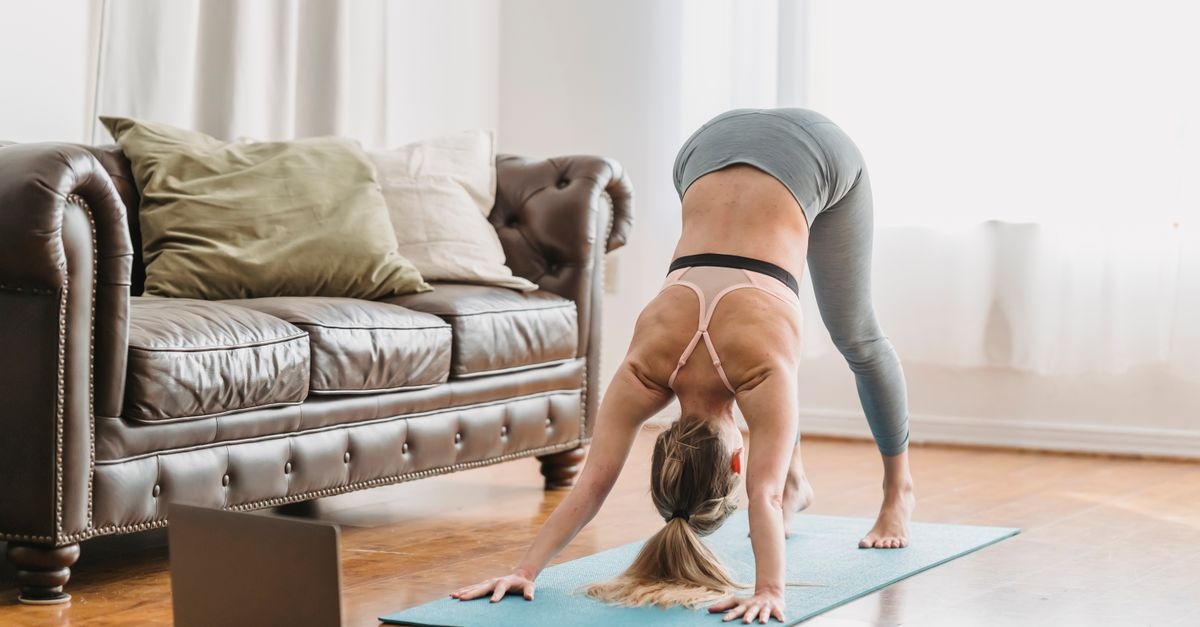
Blend mobility, balance, and strength with a dynamic flow. It’s ideal if you enjoy mindful training and want structured at home yoga workouts that still challenge your muscles.
Structure
- Warm‑up: 3 minutes (gentle joint circles)
- Flow: 25 minutes continuous movement
Flow Highlights
- Sun Salutation A x 3 rounds
- Chair pose to twisted chair x 3–5 breaths
- Warrior II → Reverse Warrior → Side Angle
- Crescent lunge → Airplane → Half moon
- Plank → Chaturanga → Upward dog → Downward dog
- Boat pose x 20–30 seconds, repeat 2–3 times
Flow on the breath; quality beats quantity. Adding a weekly yoga day complements your other at home workouts by enhancing mobility and control.
8) Tabata Power Burst
When time is tight, Tabata intervals (20 seconds on, 10 seconds off x 8 rounds per move) are potent. It’s a top pick for busy days and pairs well with other at home workouts for a balanced week.
Structure
- Choose 2–3 movements; complete all 8 rounds of one before switching
Move Options
- Jump rope (or phantom rope)
- Speed squats
- Push‑up variations
- Russian twists
Push pace during work intervals while protecting form. Done right, these short sessions are proof that intense at home workouts don’t require long durations.
9) Chair‑Assisted Strength for Joint Care
Gentle, joint‑friendly movements build confidence and capacity, making this routine one of the most easy at home workouts for seniors and for anyone returning from a layoff.
Structure
- Warm‑up: 5 minutes (seated marches, wrist/ankle circles, gentle neck mobility)
- Circuit: 2–3 rounds, 8–12 reps per move, 60–90 seconds rest as needed
Exercises
- Seated knee extension and flexion
- Sit‑to‑stand (use arms on chair as needed)
- Seated overhead press with light bottles
- Wall push‑ups
- Seated march with posture hold
Focus on posture, slow tempo, and pain‑free range. Consistent, comfortable at home workouts like this rebuild strength safely.
10) Resistance Band Total‑Body
Bands add accommodating resistance and joint‑friendly loading, making them perfect for at home workouts. This total‑body session balances push, pull, squat, hinge, and core with minimal space.
Structure
- Warm‑up: 5 minutes (band dislocates, face pulls, air squats)
- 2–3 rounds of 10–15 reps per move; 45–60 seconds rest
Exercises
- Band front squat
- Band RDL
- Standing band row
- Band chest press (anchor behind)
- Paloff press (anti‑rotation hold)
Adjust band thickness to hit the rep range with 1–2 reps in reserve. Smartly loaded at home workouts like this are joint‑kind and brutally effective.
Warm‑Up and Cool‑Down That Elevate Results
A great warm‑up primes the exact patterns in your session. Spend 5–8 minutes on dynamic mobility (hips, T‑spine, shoulders) and 2–3 low‑intensity sets of the first movement. After training, 3–5 minutes of easy walking and light stretching helps you transition to recovery so tomorrow’s at home workouts feel better, not worse.
Weekly Programming: Mix and Match
Here’s a template you can recycle for four weeks, then re‑mix. It balances strength, conditioning, mobility, and recovery so your at home workouts are effective and sustainable.
Sample 3‑Day Plan (Beginner to Intermediate)
- Day 1: Beginner Full‑Body Circuit + 10 minutes easy walk
- Day 2: Core & Mobility Flow
- Day 3: 30‑Minute Bodyweight Strength
Sample 4‑Day Plan (Intermediate)
- Day 1: Dumbbell Muscle Builder
- Day 2: Low‑Impact Cardio Circuit
- Day 3: Yoga‑Inspired Flow
- Day 4: Tabata Power Burst
Sample 5‑Day Plan (Intermediate to Advanced)
- Day 1: Dumbbell Muscle Builder
- Day 2: HIIT Intervals
- Day 3: Core & Mobility Flow
- Day 4: Resistance Band Total‑Body
- Day 5: Low‑Impact Cardio or Active Recovery Walk
Keep notes: reps, loads, intervals, and how you felt. When your log shows solid completion for two weeks, progress a variable—add a round, add 5% load, extend work intervals, or shorten rests. This keeps your at home workouts progressive without guesswork.
Goal Tweaks: Weight Loss vs. Muscle Gain
For Weight Loss
- Prioritize 3 conditioning days (low‑impact circuit, HIIT, Tabata) + 2 strength days.
- Keep intensity at RPE 6–8 on conditioning; aim for 7,000–10,000 daily steps.
- Support with protein‑forward meals and adequate hydration.
For Muscle Gain
- Prioritize 3–4 strength days (dumbbell, bands, bodyweight tempo) + 1–2 conditioning days.
- Track sets per muscle group (10–20 hard sets/week) and progress load or reps.
- Eat in a slight surplus with 0.7–1.0 g protein per pound of body weight.
Dialing these levers ensures your at home workouts align with the outcome you actually want.
Technique Tips That Compound Progress
- Tempo: Slow eccentrics (3 seconds down) make light loads feel heavy.
- Range of motion: Own full ranges before adding speed or load.
- Unilateral work: Split squats and single‑arm rows fix imbalances.
- Breathing: Inhale on the way down, exhale through the hard part.
Small technique wins multiply the results of your at home workouts over weeks and months.
Common Mistakes to Avoid
- Skipping warm‑ups: You’ll move worse and risk tweaks.
- Randomizing daily: Repeat a plan long enough to progress.
- Ignoring recovery: Sleep and steps drive adaptation.
- Chasing soreness: Progress beats pain as a metric.
A little planning turns ordinary at home workouts into a reliable system that steadily advances your fitness.
Putting It All Together
Match 2–4 of these sessions to your goals, pencil them into your calendar, and show up. Use a log to nudge a variable upward each week, sprinkle in mobility, and keep nutrition aligned with your target. The result is a streamlined training practice where at home workouts feel purposeful—and your progress finally feels predictable.